

If you tune into financial news or scroll through social media, it’s easy to get the impression that investing is entirely an offensive game. The spotlight seems to land on the hot stock of the week, massive bull runs, and traders making quick fortunes. But for those focused on protecting and growing real wealth over decades, that noise is a dangerous distraction.
I believe the secret to long-term financial security isn’t about squeezing every drop of profit out of a roaring market. It’s about protecting what you’ve built when things turn sideways. My philosophy is simple: seek to win more over time by losing less.
The brutal math of a bad year
The reason defense matters so much comes down to cold, hard math. It’s natural to assume that if your portfolio drops 20% in a bad market, you just need a 20% gain next year to get back to even.
Unfortunately, the math of loss doesn’t work that way. When you lose money, you don’t just lose the cash — you lose the compounding power that money had to grow.
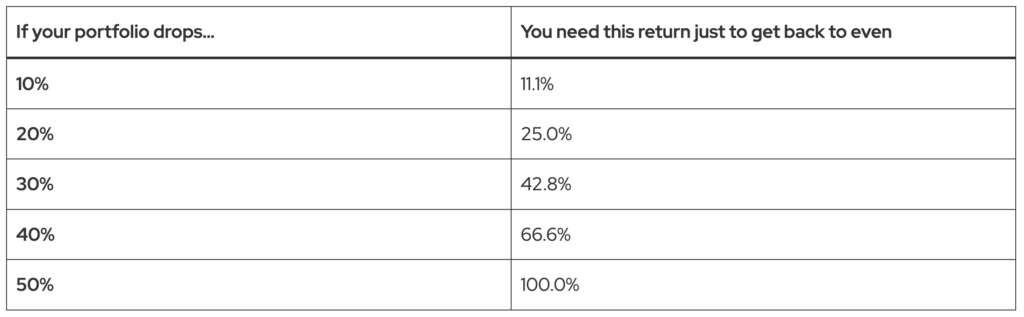
Look closely at that 50% drop. Recovering from a loss that deep doesn’t take a 50% gain — it requires a 100% return just to break even.
In the real world, that means spending years of a market cycle just trying to fix a mistake and get back to your starting line. By focusing heavily on avoiding those deep, gut-wrenching drawdowns, you don’t need to swing for the fences to stay ahead. You simply let steady, uninterrupted growth do the heavy lifting.
Take only the risk you actually need
Too often, investors take on unnecessary risk simply because they feel they “should” be beating an arbitrary index or matching their neighbor’s portfolio. They chase trends or stay fully exposed to volatile sectors even when underlying market conditions look shaky.
But risk should be treated as a tool, not a game.
I believe your portfolio should only carry as much risk as is necessary to achieve your specific personal and financial goals. If you have already built a solid foundation to fund your retirement, protect your lifestyle, or support your family, exposing that foundation to extreme market swings just to chase a few extra percentage points often creates far more anxiety than actual value.
The realistic side of playing defense
A defensive approach focuses on the quiet power of compounding. When you successfully smooth out the worst of the market’s drops, you don’t have to spend years rebuilding a damaged nest egg.
However, meaningful downside protection comes with a very real trade-off. A strategy designed to protect your capital means you will likely lag behind the broader market during aggressive, fast-moving bull runs.
True defensive investing means accepting those moments as an insurance premium. Just as you don’t complain about the cost of homeowners insurance when your house doesn’t burn down, missing out on the absolute peak of a market rally is a small price to pay for protecting your core wealth from destruction.
In the long run, steady progress and peace of mind are much easier to achieve by avoiding the deep potholes, rather than by trying to drive full speed through a storm.
Next steps
If you want to check whether your current portfolio aligns with actual goals — rather than just riding the market’s emotional roller coaster — we encourage you to reach out to your Signet advisor for a risk assessment. It’s a straightforward, eye-opening way to evaluate whether the risk you are taking matches the future you are building.
IMPORTANT DISCLOSURE
Please remember that all investing involves risk, including the potential loss of principal, and a risk assessment or consultation with an advisor does not guarantee future success or protect against market losses.
Past performance is no guarantee of future results. All investments involve risk, including the possible loss of principal. There is no assurance that any investment strategy or risk management framework will achieve its objectives or successfully avoid market losses.
This article is for informational and educational purposes only and should not be construed as specific investment, legal, or tax advice. A risk-managed strategy cannot guarantee a profit or protect against loss in a declining market. Asset allocation and diversification do not ensure a profit or protect against loss.
The mathematical table provided above is purely for illustrative purposes to demonstrate the compounding effects of portfolio drawdowns and does not reflect the actual performance or capabilities of any investment product or advisory service offered by Summit Financial.